Giving Each SaaS User a Persistent Agent Memory Layer
Persistent per-user memory fixes agent amnesia by moving state out of the context window.

An agent that asks a returning user for their shipping address again, or flatly contradicts a commitment it made last Tuesday, has not forgotten anything in the way a person forgets. Session amnesia is a design failure in how the system treats its working space, and fixing it requires rethinking what the context window is for.
Session amnesia as an architectural failure
The context window behaves like RAM, not like a hard drive: it holds whatever the current turn needs, and everything accumulated since the conversation started, including history, retrieved documents, and tool outputs, competes for a fixed amount of room. Research on agent constraint compliance found that agents followed stated preferences reliably in early turns, but compliance fell off sharply by turn sixteen, because the preference's relative weight against everything else in the window had collapsed. System prompts that govern tone, scope, and restrictions lose their relative weight as the context fills up, and agents drift from their own operating rules with no single visible trigger.
The actual fix is to stop asking the context window to hold things it was never meant to hold, and instead externalize everything that doesn't belong in the current turn to a persistent layer built for structured storage and retrieval.
What a persistent memory layer is
A persistent memory layer is a subsystem built to store, index, and retrieve information across sessions, and it solves a different problem than the tools you'd reach for first. It is not the same thing as an operational database, a RAG document index, or a workflow checkpoint, even though all three get mistaken for it.
A memory layer is built for how an LLM retrieves and reasons: it has to support semantic search, return results fast, and represent relationships between the things it stores, not just hold rows in a table.
Defining memory taxonomy before choosing storage: semantic, episodic, and procedural scopes
The most common mistake in building agent memory is starting with the storage layer and figuring out scope later. That sequence produces systems that get torn apart and rebuilt within six months, because retrieval keeps surfacing memories that don't matter and the context window fills up with noise nobody asked for. The right order runs the other way: decide what the agent actually needs to remember first, then pick storage that fits each category of that decision.
For semantic memory, the planning question is which facts about a user are stable enough to persist as-is (preferred language, role, product tier) and which change often enough to need update and expiry logic built in from the start. Whether a learned playbook belongs to one user, one tenant, or the whole system is a related decision with direct consequences for how isolation gets enforced later.
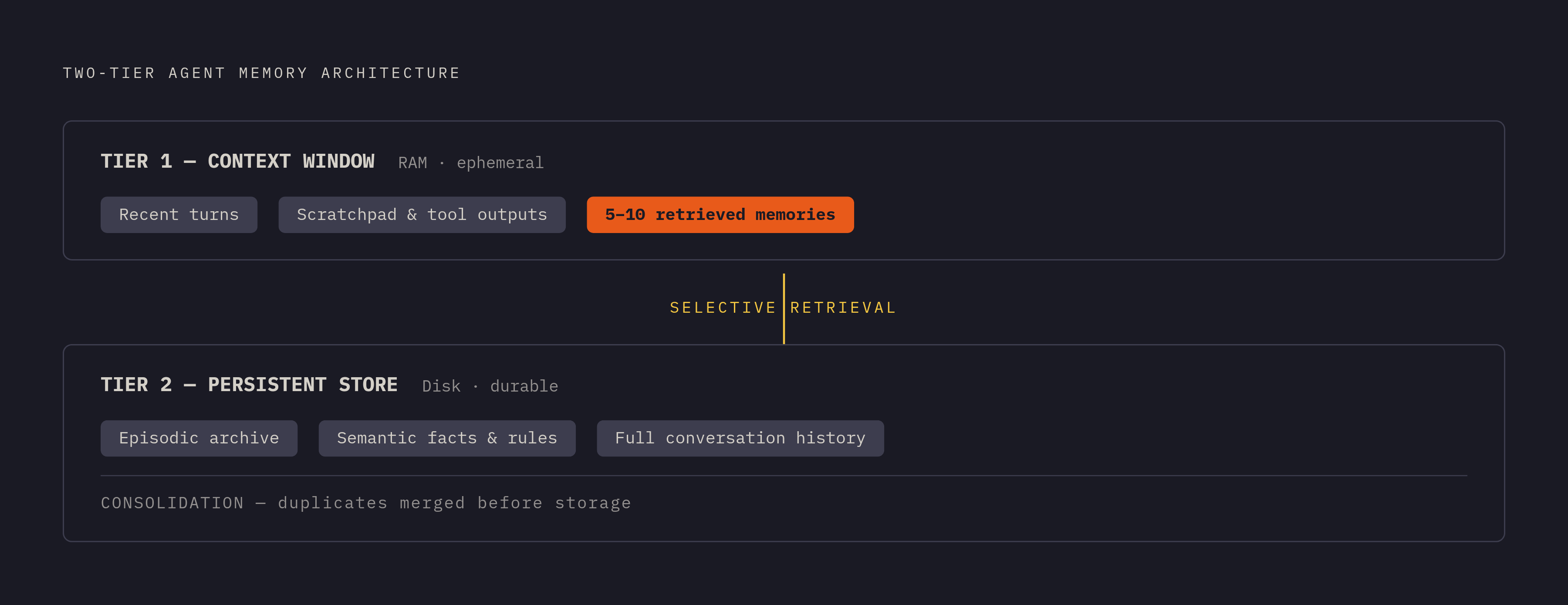
The two-tier architecture that makes per-user memory viable: context window as RAM, persistent store as disk
The production pattern that follows from this taxonomy splits the system into two tiers. Retrieval is the mechanism that pulls the right slice out of Tier 2 and puts it into Tier 1 for a given turn, and getting that mechanism right is most of the architecture.
Tier 1 should hold only a few things: the most recent turns, not the entire conversation history; the current scratchpad covering the task at hand and whatever tool outputs this turn produced; and a small set of memories retrieved specifically because they're relevant to this prompt. Production guidance puts that retrieved set at five to ten memories per turn, not a dump of everything the system has ever stored about the user. Tier 2 holds the rest: every prior episodic memory, every semantic fact, every procedural rule, indexed so it can be found fast; the full conversation archive, searchable rather than injected wholesale; and anything scoped to the user that needs to survive sleep, redeploy, or a long gap between sessions.
Making this work in practice depends on a few retrieval disciplines: selective retrieval that brings back a small relevant slice instead of replaying full history, consolidation that merges duplicate memories and promotes patterns that keep recurring into a shorter working model, and temporal reasoning that can tell what used to be true from what is true right now.
Per-user memory scoping as the decision that separates genuine personalization from shared-context simulation
If memory gets scoped to a user only at the query layer, through a filter applied when reading, rather than at the data boundary itself, it will eventually leak across users and fail any serious governance review.
Three failure patterns appear when per-user scoping isn't enforced structurally. A right-to-be-forgotten request requires removing all of a user's data, and in a shared index without hard boundaries, that turns into a query-and-purge operation that is slow, prone to missing records, and hard to audit without building extra tooling on top.
The model that avoids all three treats memory scoping the way a filesystem treats user accounts: the boundary is structural, built into how data is stored. Retrofitting it into a system built on a single shared namespace is expensive, and it's the kind of expense that grows with every user already stored in that namespace.
Memory governance as a launch requirement: inspect, correct, delete, and expire from day one
Governance tooling, letting users inspect what's remembered about them, correct it, delete it, and letting the system expire facts automatically, is a decision that has to be made before memories start accumulating, not after. Once a system has real user data sitting in a live memory store, adding these capabilities retroactively means reprocessing every derived summary, rebuilding indexes, and auditing every cache that might hold a copy of something that was supposed to be deleted. That work is a fraction of the cost if it's designed in from the start.
Four things need to exist at launch.
Temporal reasoning, the ability to tell what used to be true from what is true now, belongs on the retrieval side, not just in how data gets stored. A system without it will confidently hand back a fact that's already been superseded. Provenance matters for the same reason: a remembered claim should be traceable to when it was stored, which session it came from, and what source it was derived from. That traceability is what separates a memory system an enterprise can actually audit from one it can only hope is working correctly.
The memory layer landscape in 2026
No single memory tool is the right answer for every system in 2026. You need whichever tool's persistence boundary, retrieval model, and governance features match the taxonomy and scoping decisions you already made earlier in the design process.
Mem0 is the default path for per-user chat personalization inside a product. It supports user-level, session-level, and agent-level memory scopes, and it retrieves with a hybrid approach combining semantic search, BM25, and entity matching, filtered through metadata. It offers a managed free tier with paid scale-up, and Cognee's guide to the space treats it as the fastest route to cross-session personalization for a team that doesn't want to commit to a temporal graph or a file-native runtime up front.
Zep, built on Graphiti, is the managed option suited to temporally complex or regulated use cases. That makes it a good fit for customer-success agents that need to preserve a longitudinal record of a relationship over time, and it offers a free tier at ten thousand credits a month.
A managed layer is available through LangGraph Platform, though the core SDK is self-hosted, giving teams maximum control over how memory behaves at the cost of building more of it themselves.
A question like "what did the client say about the budget after the contract was signed" needs relationship traversal, not nearest-neighbor similarity search, and Cognee reports roughly ninety percent accuracy on contextual queries of that kind, against roughly sixty percent for plain RAG retrieval.
Vector-only stores like Pinecone or Chroma are a reasonable starting point but not a full memory architecture on their own. They store embeddings and return similar passages well, but they don't decide on their own whether a fact has been superseded, whether a new correction should overwrite an old observation, or whether a given preference belongs to a user, an agent, a specific run, or an entire organization. Those decisions still have to be built on top.
The compute layer under the memory layer and economic scaling
A memory architecture built correctly on paper still fails in production if the compute underneath it can't support real per-user isolation at a cost that scales. An agent whose state has to survive sleep, redeploy, and long idle stretches cannot run on a stateless serverless function or in a container shared with other users without giving up the isolation the memory layer was built to guarantee.
A microVM with its own guest kernel solves the problem at the right layer. Firecracker gives each agent a genuinely separate kernel boundary rather than a shared kernel with extra restrictions layered on top, so a compromised agent can't reach another user's environment or memory. It boots in roughly 125 milliseconds and carries about 5 MB of memory overhead, numbers that make spinning up a dedicated VM per user an operationally realistic choice. AWS Bedrock AgentCore runs each user session in its own dedicated microVM with isolated CPU, memory, and filesystem, and stands as the clearest production validation of this pattern at scale.
Isolation alone doesn't solve the economics: most agents sit idle most of the time, and billing idle compute at the same rate as active compute makes running one agent per user unaffordable. Production implementations of this pattern reach sub-200 millisecond end-to-end restore times at the p50 mark, with roughly 203ms at p99, fast enough that waking an agent back up is invisible to the person using it. A persistent disk attached to each agent is just as necessary as the compute itself: files, credentials, browser sessions, and installed packages all need to survive sleep and redeploy, so the agent accumulates context as a collaborator would instead of resetting every time like a disposable tool.
How MCP changes the memory retrieval interface
The Model Context Protocol has become the standard way agents connect to outside systems, memory stores included, through one consistent tool interface.
MCP gives memory-connected agents a JSON-RPC 2.0 interface that works the same way whether the transport is stdio or Streamable HTTP, so an agent calls a memory server the same way it calls any other tool, with no framework-specific adapter needed in between. The 2026-07-28 specification update made the protocol fully stateless at the protocol layer, removing the session-pinning problem that used to force sticky routing, block autoscaling, and lose state whenever a pod restarted, a real improvement for any system serving more than one tenant at a time. Stable SDKs for Python, TypeScript, Go, and C# shipped alongside that update, giving teams working in any of those languages a direct path to building on it.
For multi-tenant systems, the practical recommendation is to expose every capability, memory read and write included, as its own MCP server rather than wiring tools directly into the agent's binary.
The SaaS pricing implication: per-user agents require a cost model that is not per-seat
Once an AI agent is doing the work instead of a person sitting at a desk, per-seat pricing stops making sense, because an agent's cost is driven by how much it does, not by how many people are logged in. A per-user persistent agent needs a pricing model built around the gap between idle and active economics, not a flat fee per login.
The market is already moving toward usage-based, outcome-based, and hybrid pricing that reflects how agents actually cost money to run. Intercom's Fin AI agent charges per resolution, billed when a customer confirms their issue is resolved, when they don't ask for more help after Fin responds, or when Fin completes a full workflow, including handoffs, and that model scaled the product to over one hundred million dollars in ARR. Salesforce Agentforce shows the range available today: a per-user license, flex credits, and per-conversation pricing all exist as options, though only flex credits are available across both the PayGo and Pre-Commit buying models, while conversation-based pricing and per-user add-ons sit outside those two. Seat-based pricing has fallen off across SaaS broadly while hybrid models have grown, and the direction of that shift is clear.
Requirements of "whatever the user can do in the UI, the agent can do through tools
The guiding principle for an agent-native SaaS product is simple to state: anything a user can do through the interface, the agent should be able to do through tools. That principle isn't a slogan, it's a requirement that shapes memory, compute, and tooling decisions before the first production deploy.
On the memory side, it means every action that creates or changes state through the UI needs a matching write path into the memory layer, so the agent's understanding updates whenever the user's context does.
Every decision in this piece follows from the one before it. Defining the memory taxonomy first is what makes the two-tier design workable. The two-tier design gives per-user scoping its meaning. Per-user scoping is what makes governance tractable. Governance at launch is what a microVM and snapshot-restore compute model exist to support economically. That compute model is what makes a usage-based pricing structure viable. And MCP is the interface that ties the memory layer to the agent runtime across all of it, consistently, no matter which tool sits behind the connection. None of these are independent choices made at different points on a roadmap. They are one architecture, built in the right order.