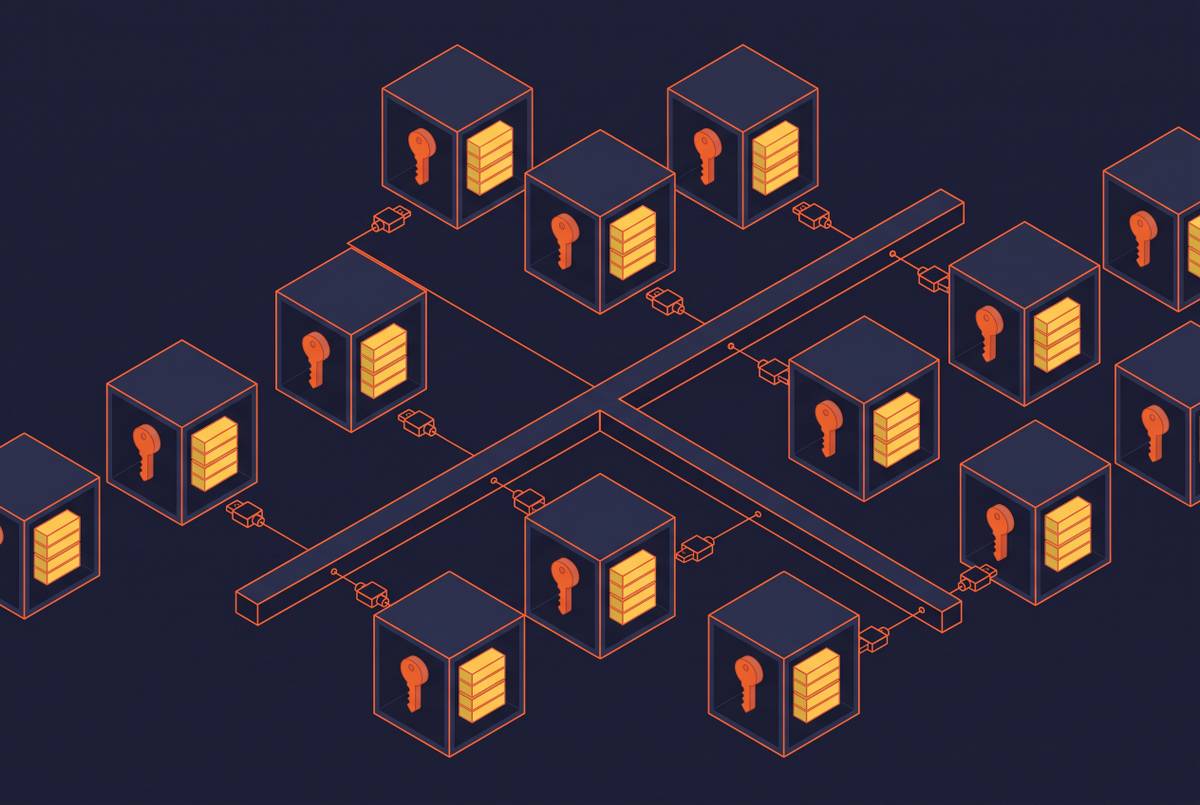
Agent-Native SaaS vs Traditional Feature-Driven SaaS Architecture
Agents running continuously rewrite state, permissions, pricing, and compute.
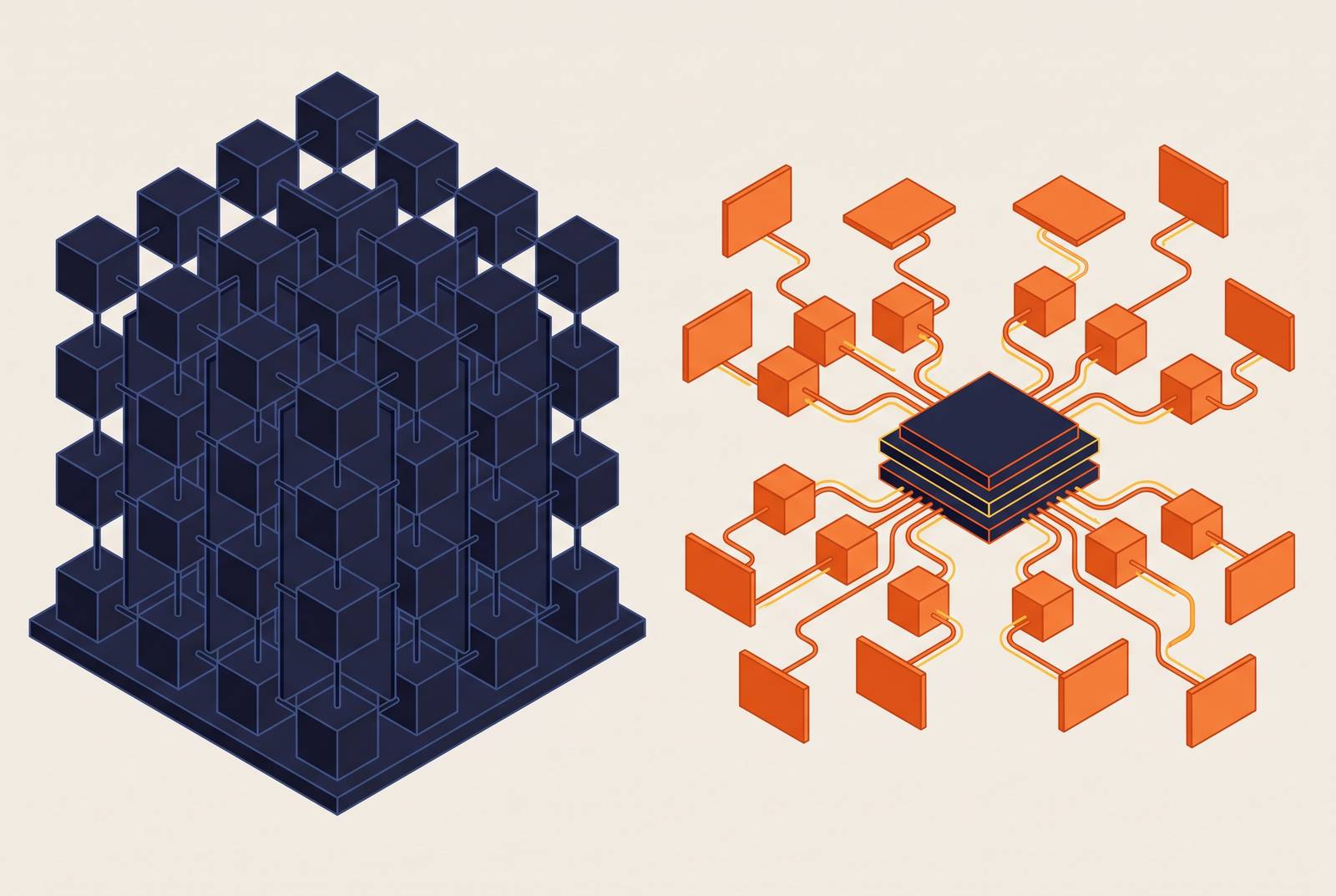
Agent-native SaaS is a distinct architecture, and it isn't a feature set layered onto existing software. It assumes an agent is always running and acting on its own, rather than waiting for a human to click, and that single inversion changes state management, permissions, pricing, and compute all the way down. If you're deciding what to build on now, you have to choose: retrofit systems built for human clicks, or build on infrastructure made for persistent, isolated, always-on agents from the start.
How Traditional SaaS Was Architected
Traditional SaaS rests on one assumption that shaped everything built on top of it: a human being initiates every meaningful action. Every part of the stack, from how permissions get assigned to how a bill gets calculated, was built in service of that single assumption.
Bolting AI Onto That Architecture Produces a Sophisticated Wrapper
Adding an AI layer on top of a system built for human pacing produces something that can draft, summarize, and suggest, but can't execute, learn, and adjust inside a loop that closes in milliseconds instead of days. The pipelines, permission checks, and triggers that sit beneath the surface still assume a person will come back to finish the job. Dropping a large language model on top of that stack means it inherits every one of those constraints: it can write a first draft of an email or a plan, but someone still has to click send, and the loop that closes the task stays exactly as slow as the human closing it.
This is path dependence at work: where a platform ends up depends not just on where its roadmap says it's going, but on every architectural decision made before that roadmap was written. During those years, companies that build agent-native from day one keep accumulating production usage, trained models, and customer data already shaped for how agents actually work.
The standard response to this is that incremental modernization will get incumbents there eventually: add an API here, a webhook there, a copilot on top. The question that exposes this cleanly is simple: can the system distinguish an agent making a decision from a human making one? For most platforms built before agents were part of the picture, the honest answer is no.
What agent-native architecture looks like structurally
Agent-native SaaS starts from the opposite assumption: an agent is always running, not waiting for a human to come back to the interface. That one inversion changes every layer built on top of it. An agent-native platform treats the agent as a resident of the system, with its own space and its own standing, rather than as a guest that has to come in through the same front door a human uses.
State management has to change first. Permissions change too: an agent's allowed actions have to be a first-class design decision, not a side effect of whatever role a human happened to be assigned. A product has to decide explicitly whether an agent can observe, recommend, draft, update, or execute, and those boundaries need to be enforced at the infrastructure level rather than buried in a backlog of engineering tickets.
The event model shifts from clicks to conditions. Without it, there's no way to improve agent behavior safely after launch or to tell which outputs users actually trust.
Two orchestration patterns serve as the structural building blocks that replace the human-navigated workflow: the orchestrator-worker pattern, where a central coordinator hands work to specialized agents, and the hierarchical agent pattern, where higher-level agents assign sub-tasks to agents below them. An agent can't reason about its own history without it.
This breaks down if the data feeding it is a mess. If product events, CRM records, support history, and account data sit scattered across systems with no consistent permission model, agents will produce incomplete and untrustworthy output no matter how good the model is. Data architecture is agent architecture, so you can't clean it up later as a separate concern.
Persistent, Isolated Compute as an Infrastructure Prerequisite for Agent-Native Architecture
Persistent state and real isolation make the architecture described above buildable at all; without them it is not merely slower at agent workloads, it cannot run them. Every invocation starts cold, and an agent that starts cold every time works more like a script than an agent.
Firecracker micro-VMs solve this by giving each workload its own kernel running on hardware virtualization, so a kernel exploit inside one VM has no path to the host or to any other VM.
GPU workloads expose a real limitation in this model. Firecracker's virtualization path doesn't support VFIO device passthrough, since its device model runs virtio-over-MMIO with no PCI bus, so GPU passthrough isn't available in stock Firecracker. Cloud Hypervisor, a related Rust-based virtual machine monitor, does support VFIO passthrough and gives workloads near-native GPU performance. gVisor takes a different approach entirely: instead of passthrough, it proxies GPU driver calls through nvproxy from its user-space kernel.
The economics follow directly from the architecture. Most agents spend most of their time idle, so a scheduler built around snapshot and restore lets a platform charge for storage while an agent sleeps and for compute only while it's actually working. That's what makes deploying one agent per user viable at any real scale, so it's not just an expensive novelty.
Retrofitting a human-paced SaaS stack for continuous agent activity means rebuilding persistent state, real-time pipelines, and per-agent isolation, which is the deeper infrastructure issue, and platforms built on stateless serverless assumptions struggle to adapt to that. Teams building agent-native products from the ground up are increasingly choosing infrastructure made for always-on, isolated agents, where each one runs in its own persistent environment and keeps its state across sessions, rather than trying to bend request-response infrastructure into a shape it wasn't built for. Maritime is one example built directly on this model: each agent runs inside its own isolated Firecracker micro-VM on bare metal, with a persistent disk, a real kernel, the ability to install packages, and a wake time from sleep under a second. Its snapshot-and-restore scheduler means idle agents pay for storage rather than compute, which is what makes running one agent per user practical for a startup as well as a company operating at scale.
How agent-native architecture breaks per-seat pricing
Per-seat pricing doesn't just get awkward when agents act as users. It stops making sense, because consumption no longer tracks headcount in any reliable way. Charge per seat in an agent-native product and the result breaks in one of two directions: underprice, because a single agent can do the work of many humans and the vendor bleeds revenue, or overprice, because customers end up paying for seats that correspond to no actual person and leave.
The market response has been to move toward usage-based billing: charging for tokens consumed, actions performed, or credits used. Salesforce Foundations is free and includes Agent Builder and Agent Script, but usage runs on Flex Credits, priced at $500 per 100,000 credits, and a standard action costs 20 credits.
Microsoft's Agent 365, generally available since May 1, 2026, makes the architectural split even more explicit. But building and running those agents costs extra, and you pay for it separately through Azure via Copilot Studio or Foundry consumption, because Agent 365 itself carries no consumption charges. That split is the architecture made visible in a price list: governance follows human-seat logic, while execution follows consumption logic, and Microsoft's pricing keeps the two cleanly separated.
Both of these share the same cost problem in miniature. The snapshot-restore model, paying for storage while idle and for compute only during execution, is the architectural fix to that pricing problem, not just a convenience. So you end up tracking token usage and action counts, not seat counts, as a baseline operating requirement for running the business, and any team can do it, not just finance.
How agent permissions differ from role-based access control
Role-based access control was built for humans who can read a permission-denied message and decide what to do next. That design doesn't hold up for agents acting on their own and at speed. Agent-native systems need a graduated, action-scoped permission model built into the architecture from the start, not RBAC with extra steps.
Traditional RBAC assigns permissions to roles and roles to users, and it assumes a person will read the outcome of an action before deciding what happens next. If the permission model doesn't scope what the agent is allowed to do ahead of time, the agent can take an action that can't be undone before any human has the chance to step in.
What a graduated model actually requires is a product deciding, explicitly, whether an agent may observe, recommend, draft, update, or execute. The Plan-and-Execute pattern is useful here precisely because it separates planning, generating a full multi-step plan, from execution, running each step in order, and that separation creates a natural checkpoint where a human or a governance layer can review the plan before anything irreversible happens.
This has become a real buying criterion for enterprise software, not a technical footnote. Only a small share of companies currently trust agents to run core business processes without a human in the loop, and that caution is a direct signal that permission and reversibility architecture drives adoption more than it drives compliance checklists. When AI-native applications and autonomous agents spread faster than governance structures do, the risk of data exposure and ungoverned agent behavior, sometimes called shadow AI, grows right along with them. Governance has become one of the largest barriers to enterprise adoption of agents, not an afterthought bolted on once a product ships.
What the MCP protocol layer reveals about agent-native interoperability
Agent-native SaaS needs a standard way for agents to discover and call tools across system boundaries, and the Model Context Protocol has become that layer, with adoption wide enough that it now counts as infrastructure. Traditional SaaS interoperability ran on REST APIs and webhooks built for human-initiated requests. Agents need something different: a way to discover what tools exist, call them, and compose them together dynamically, without a person wiring up each integration by hand.
MCP fills that role because it defines a standard interface between agents and the tools and data sources they act on. OpenAI, Google, Microsoft, and Salesforce all added support for it within 13 months of its launch. The Agentic AI Foundation, a directed fund operating under the Linux Foundation, now governs it, and that gives it the kind of neutral stewardship infrastructure protocols need if competing vendors are going to trust it.
The MCP v2 specification, finalized in July 2026, is the largest revision the protocol has seen, and it stabilized several changes you need to know precisely. Tools moved to full JSON Schema 2020-12.
Transport choice matters for anyone actually deploying this. stdio remains the right choice for local development and locally-run agents, Streamable HTTP is the standard transport for cloud-hosted MCP as of 2026, and SSE is now legacy for any new deployment. The practical path to building an MCP server follows a predictable sequence: spec out the tool surface, scaffold it with the official TypeScript or Python SDK, build it first as a local stdio server, test it in the MCP Inspector, run it against a real agent, then swap the transport to Streamable HTTP and add OAuth 2.1 before deploying. Each step costs little on its own, making MCP adoption a reasonable starting point for a team.
The architectural role MCP plays is the same role HTTP played for human-facing web applications: a boundary layer between an agent's reasoning loop and the external world of tools, APIs, and data it needs to act on.
Why agent-native differentiation is structurally durable
A summary box, a basic chat assistant, or a generic recommendation panel runs on the same underlying model and the same shallow context as every competitor's version of the same thing, so the gap in value stays thin and easy for a rival to close. Agent-native architecture behaves differently: the differentiation it creates is built into the system's memory, context, and execution model, and that kind of advantage compounds over time.
Workflow-level AI is harder to copy because it's tied to the actual product journey: knowing when to assist, when to escalate to a human, when to ask for approval, and when to do nothing. The feedback loop described earlier in this piece, capturing corrections, approvals, rejections, and failed outputs, is where that advantage compounds, because a product with that loop built in can improve its agent's behavior in ways a feature pasted onto someone else's infrastructure simply can't.
Trust works the same way. This creates a real line through the SaaS market: categories whose value is mostly interface and manual coordination are the most exposed to agent-based disruption, while platforms that serve as systems of record, permission layers, or transaction engines tend to stay durable. Which side of that line a given product sits on is a question of architecture, not branding.
Gartner forecasts that a significant share of agentic AI projects will be canceled by the end of 2027 over cost, unclear value, or weak risk controls, and those failures will cluster disproportionately around products that deferred the structural decisions laid out in this piece, state management, permissions, observability, and pricing, until it was too late to fix them cheaply. For developers deciding what to build on now, the right primitive is a persistent, VM-isolated agent that lives on the cloud with its own space, its own memory, and continuity across sessions, the per-user agent model, rather than a thin layer stretched across infrastructure built for something else. Maritime's architecture, each agent in its own Firecracker micro-VM, a persistent disk, sub-second wake from sleep, and flat-rate economics, is built for developers working at exactly this layer, so that infrastructure overhead isn't what stands between an agent-native product and actually reaching production.